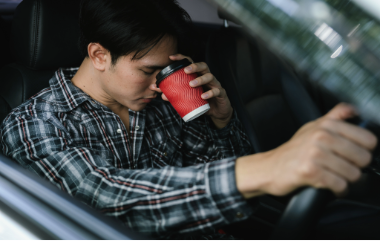
Have you ever struggled to keep your eyes open while driving? You are not alone. An American Academy of Sleep Medicine survey found that 41% of adults have felt so sleepy while driving that it affected their ability to drive safely.
Drowsy driving can put you, your passengers, and everyone else on the road at risk. Warning signs include frequent yawning, drifting into another lane, or nodding off. If you notice these signs, pull over in a safe place and get some sleep.
Many people try quick fixes to stay awake. In the survey, 65% of sleepy drivers said they drank coffee or another caffeinated beverage. Others opened a window, turned up the radio, drank water, or ate a snack.
These steps may make you feel more alert for a short time. But they cannot replace sleep. If you are too sleepy to drive, the safest choice is to stay off the road.
How sleepiness affects driving
You do not have to fall asleep at the wheel for drowsy driving to become dangerous. Sleepiness can slow your reaction time and affect your judgment. It also can lead to more mistakes.
In fact, research from the AAA Foundation for Traffic Safety found that drivers who typically sleep only four to five hours per day have 5.4 times the crash rate of drivers who get seven or more hours of sleep. The risk is so significant that getting only four to five hours of sleep before driving is associated with a crash risk comparable to driving with a blood alcohol concentration (BAC) of 0.08, the legal limit for alcohol impairment in most states. Getting less than four hours of sleep is associated with an even greater risk, comparable to driving with a BAC of 0.12 to 0.15.
A sleepy driver may have a microsleep. This is a brief episode when awareness drops out. Even a few seconds can lead to a loss of vehicle control.
Drowsy driving is more common than many people realize. A study of crash investigation data found that an estimated 17.6% of fatal crashes between 2017 and 2021 involved a drowsy driver. During that five-year period, an estimated 29,834 people were killed in crashes involving drowsy drivers. These findings show that driving while sleepy can have serious and sometimes deadly consequences.
Tips to prevent drowsy driving
Plan for enough sleep before you get behind the wheel. In support of the National Sleep Foundation’s Drowsy Driving Prevention Week® (Nov. 1-7), the AASM recommends these tips to help keep you safe on the road:
- Sleep for seven or more hours before driving. This is how long the AASM recommends adults sleep each night on a regular basis to promote optimal health.
- Avoid driving late at night. Drowsiness is more likely during the late-night and early-morning hours, so avoid driving during these times whenever possible.
- Avoid driving alone. If you must travel when you’re tired, having another person in the car can provide an extra set of eyes to help recognize the signs of drowsiness.
- When taking a long trip, share the driving with another passenger. On long road trips, take turns driving with a well-rested passenger so everyone has an opportunity to rest before getting behind the wheel.
- Pull over at a rest stop and take a nap. If you become drowsy while driving, pull over at a safe location and take a short nap rather than trying to push through the sleepiness.
- Arrange for someone to give you a ride home after working a late shift. If you’re too tired to drive safely after a late shift, arrange for a ride with someone who is well-rested or use another form of transportation.
Make sleep part of your travel plan
Before you drive, ask yourself whether you are rested enough to stay alert. If the answer is no, delay the trip, share the driving, or find another way to get where you need to go.